


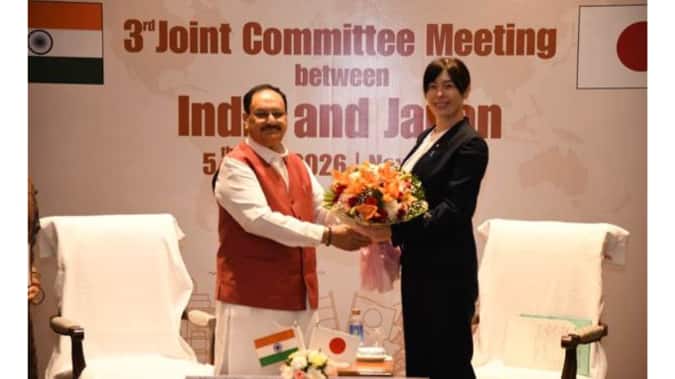
India and Japan moved to deepen their strategic cooperation in healthcare, signalling a sharper focus on resilient systems, innovation, and accessibility at a time when global health priorities are rapidly evolving.
At the third Joint Committee Meeting (JCM) on Healthcare held at Bharat Mandapam, Union Health Minister JP Nadda underscored that the bilateral partnership is no longer limited to conventional exchanges but is increasingly anchored in a “shared vision” of building future-ready health ecosystems. The meeting was co-chaired by Japan’s minister in charge of healthcare policy, Kimi Onoda.
The dialogue, held under the India-Japan Memorandum of Cooperation in healthcare and wellness, has emerged as a key institutional mechanism for driving sustained engagement between the two countries. Health Secretary Punya Salila Srivastava described the platform as instrumental in fostering “regular dialogue and deeper mutual understanding,” reflecting the growing strategic convergence in public health priorities.
For New Delhi, the partnership fits into a broader narrative of inclusive development and system strengthening. Nadda reiterated India’s commitment to expanding access and innovation under its development framework, while also pointing to the historical depth of India-Japan ties spanning over a century.
The discussions themselves were wide-ranging but sharply focused on emerging pressure points within healthcare systems. A significant portion of the deliberations centred on non-communicable diseases (NCDs), which continue to pose a mounting economic and public health burden. India outlined its multi-layered strategy built on large-scale screening, continuity of care, and sustained health awareness aligned with its Sustainable Development Goals roadmap.
Japan, for its part, brought to the table its experience in early cancer detection and advanced treatment ecosystems, highlighting opportunities for technical collaboration. The emphasis on early diagnosis and preventive care reflects a shared understanding that long-term healthcare costs can be significantly reduced through timely intervention.
Supply chain resilience is another critical theme that drew attention against the backdrop of recent global disruptions. India showcased the strength of its pharmaceutical and medical devices sectors, with a clear policy push towards domestic manufacturing and affordability. Japan highlighted its public-private partnership model, which has been central to ensuring both quality and reliability in medical product distribution.
Digital health emerged as a key pillar of future collaboration. India presented its digital public infrastructure model under the Ayushman Bharat Digital Mission, positioning it as a scalable framework for healthcare delivery. Japan, meanwhile, emphasised its advancements in system integration, artificial intelligence, and collaborative research, opening avenues for cross-border innovation.
The meeting concluded with a sense of renewed momentum. For both countries, the evolving partnership is not merely about bilateral cooperation but about shaping resilient and inclusive healthcare systems that can withstand future shocks while expanding access.
As Nadda noted in his closing remarks, the discussions have set a “clear direction” for the next phase of engagement, one that blends policy alignment with technological collaboration and positions India-Japan ties as a significant force in the global health landscape.